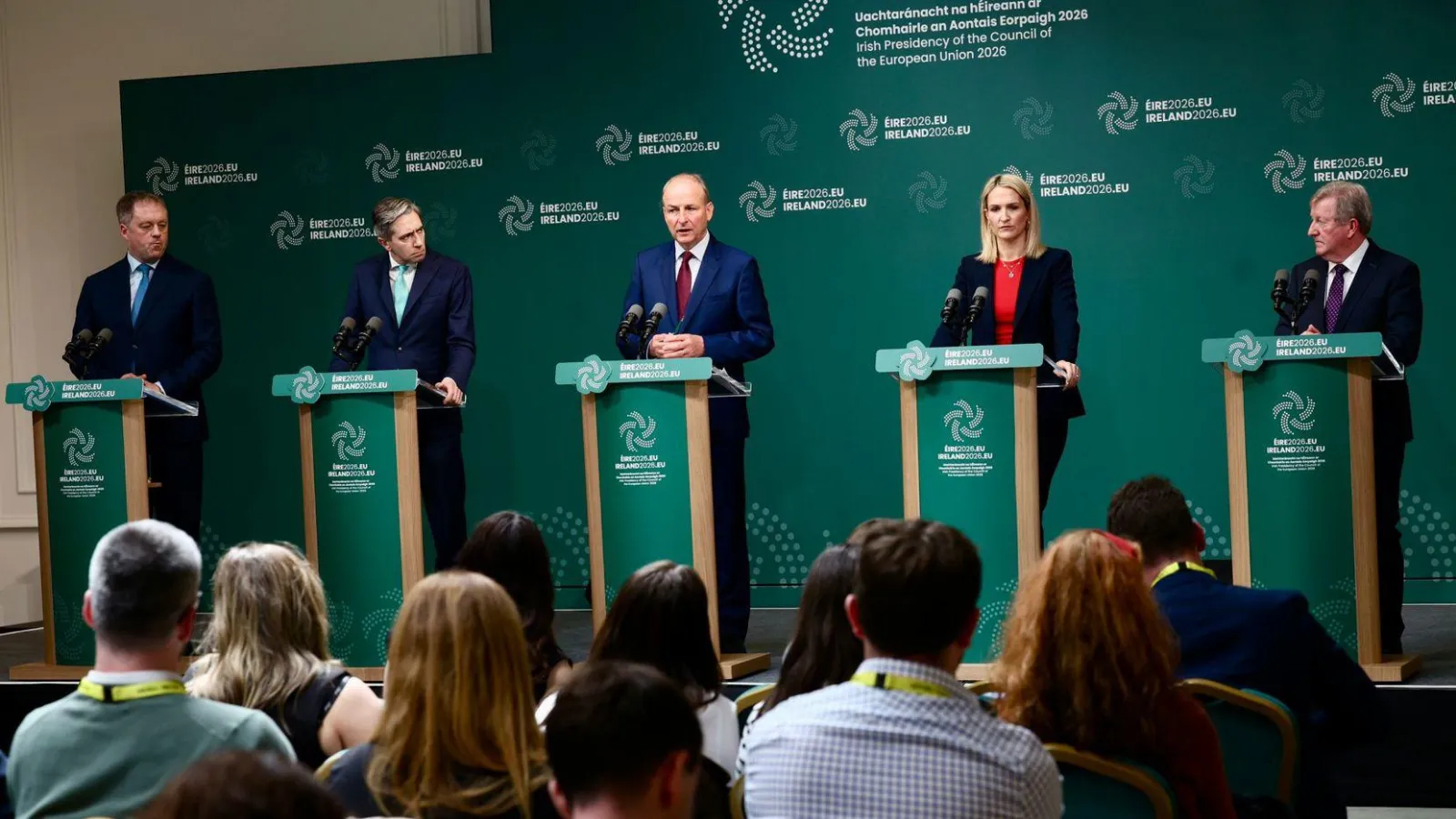
European Leaders Prepare for Dublin Summit as Security and Economic Resilience Top Agenda
The ninth European Political Community gathering is scheduled to bring 48 invited heads of state and government together as continental security, democratic resilience and economic competitiveness dominate the agenda.
European leaders are preparing to meet in Dublin on Thursday for the ninth European Political Community summit, a high-level gathering intended to strengthen political coordination amid growing security and economic uncertainty across the continent.
The meeting is scheduled for 12 November and will be co-chaired by European Council President António Costa and Irish Taoiseach Micheál Martin.
According to the European Council, 48 heads of state and government have been invited to participate, including leaders from the European Union, the United Kingdom, Ukraine, Türkiye, Armenia, Moldova and other European countries. Canada has also been invited as a guest.
The summit’s overall theme is a strong, secure and connected Europe.
The official agenda highlights two principal priorities: building a more competitive Europe through innovation, connectivity and affordable energy, and strengthening the continent’s ability to defend democracy and security.
The meeting is taking place against the background of Russia’s war against Ukraine, continuing concerns about European defence capabilities and wider uncertainty over the future of transatlantic relations.
Ukraine’s diplomatic position is particularly relevant.
President Volodymyr Zelenskyy was in Dublin on 11 November, where he met Lithuanian President Gitanas Nausėda and briefed him on the recent US-mediated negotiations between Russia and Ukraine in Abu Dhabi.
Zelenskyy confirmed that the parties had reached an understanding on a potentially large prisoner exchange, although the final arrangements remained pending.
The Dublin gathering also provides an opportunity for European governments to discuss how security, energy policy and economic competitiveness are increasingly interconnected.
For many European economies, affordable energy remains essential to industrial competitiveness, household costs and the transition towards lower-carbon energy systems.
The European Political Community was established in 2022 as a forum for political dialogue between European countries, including states that are not members of the European Union.
Its purpose is to facilitate cooperation on common challenges without replacing existing EU or other international institutions.
The meeting in Dublin will be followed on Friday, 13 November, by an informal gathering of EU heads of state or government.
At the time of preparation of this report, the Dublin summit had not yet opened and no final declaration or summit outcome was available.
Its significance will ultimately depend on whether leaders translate their discussions into practical cooperation on Ukraine, security, energy and economic resilience.
Research and reporting sources
- European Council — Ninth European Political Community summit, 12 November 2026
- European Council / Irish Presidency — Official summit programme and arrangements
- President of Ukraine — Zelenskyy meets Lithuania’s president in Dublin, 11 November 2026


